
Research summary · 2022
Evaluating Monthly Flow Prediction with SWAT, Support Vector Regression, and Discrete Wavelet Transform
A SWAT–WSVR framework that combines process-based modeling, support vector regression, and wavelet decomposition for monthly streamflow prediction in data-limited watersheds.
Research snapshot
Can wavelet decomposition strengthen a hybrid SWAT–SVR framework for multi-site monthly streamflow prediction?
SWAT-CUP · discrete wavelet transform · support vector regression · 12 hydrologic sites
Demonstrates physics–data integration that improves prediction while retaining watershed-process representation.
 Open full-resolution figure
 Research Question
Can discrete wavelet decomposition improve a hybrid SWAT–support vector regression framework for monthly streamflow prediction across multiple monitoring sites in a watershed with limited observations?
Why It Matters
Reliable monthly streamflow estimates support water-resources planning, drought and flood assessment, reservoir management, and agricultural water management. Process-based watershed models can be difficult to calibrate at multiple locations, while observed hydrologic series are nonlinear and nonstationary. A hybrid approach can retain SWAT’s watershed representation while using machine learning to correct remaining prediction errors.
Methods
- Developed and evaluated the framework at 12 hydrological sites in the Illinois River watershed, U.S.
- Decomposed SWAT-CUP simulated streamflow and precipitation time series using discrete wavelet transform.
- Used the resulting wavelet components as inputs to support vector regression.
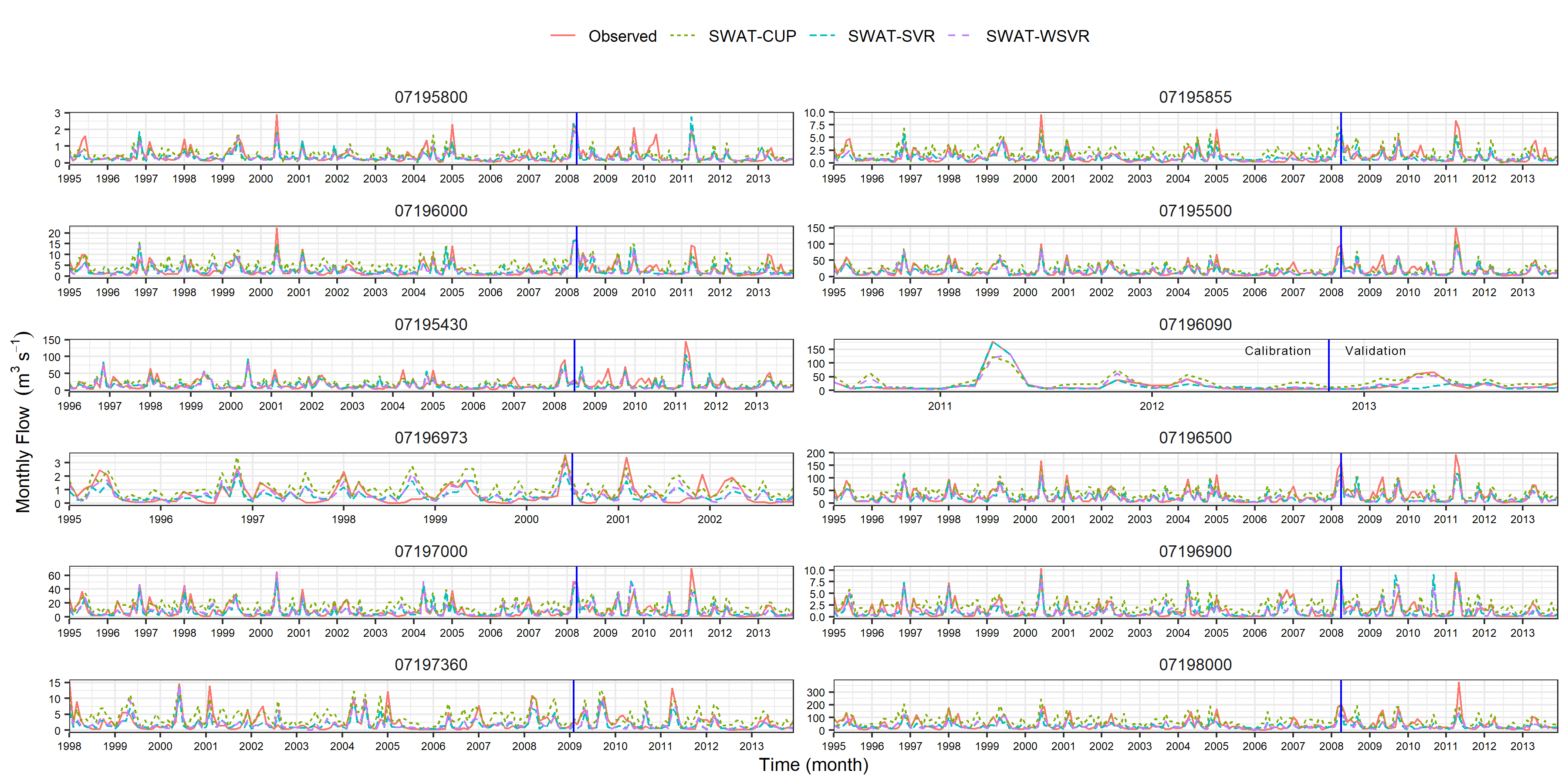
- Compared SWAT–WSVR with observations, conventional SWAT-CUP, and SWAT–SVR using hydrographs, Taylor diagrams, and standard hydrologic performance metrics.
Key Findings
- Overall model performance ranked SWAT–WSVR > SWAT–SVR > SWAT-CUP.
- Across the 12 sites, mean Nash–Sutcliffe efficiency was 1.00 during calibration and 0.98 during validation.
- Mean percent bias was −0.15% during calibration and −1.88% during validation.
- The wavelet-enhanced framework reduced discrepancies and improved monthly streamflow accuracy relative to the two comparison approaches.
- The method provides an additional calibration strategy for data-limited watersheds.
My Contribution
According to the published author-contribution statement, Lifeng Yuan contributed to conceptualization and was responsible for methodology, software, validation, formal analysis, investigation, visualization, and preparation of the original manuscript draft. He also contributed to reviewing and editing the final manuscript.
Practical Relevance
The study demonstrates how signal decomposition and machine learning can complement a process-based watershed model, providing a practical example of physics–data integration for multi-site hydrologic prediction.