
Research summary · 2021
Enhanced streamflow prediction with SWAT using support vector regression for spatial calibration: A case study in the Illinois River watershed, U.S.
A hybrid SWAT–SVR approach for spatial calibration and monthly streamflow prediction in the Illinois River watershed.
Research snapshot
Can support vector regression improve spatial calibration of SWAT streamflow predictions where gauge data are limited?
SWAT · support vector regression · 13 USGS stations · leave-one-out validation · flow-duration analysis
Reduces calibration burden and supports regional streamflow prediction in data-limited or ungauged basins.
Research Question
Can support vector regression use process-based SWAT output and spatial information to improve monthly streamflow prediction where conventional multi-site calibration is costly or observations are limited?
Why It Matters
Rainfall–runoff relationships are nonlinear, and process-based, conceptual, and data-driven models each have limitations. SWAT calibration can be data-intensive and time-consuming, particularly across multiple locations, while standalone machine-learning models require sufficient observations. A hybrid method can combine physical watershed representation with efficient nonlinear correction.
Methods
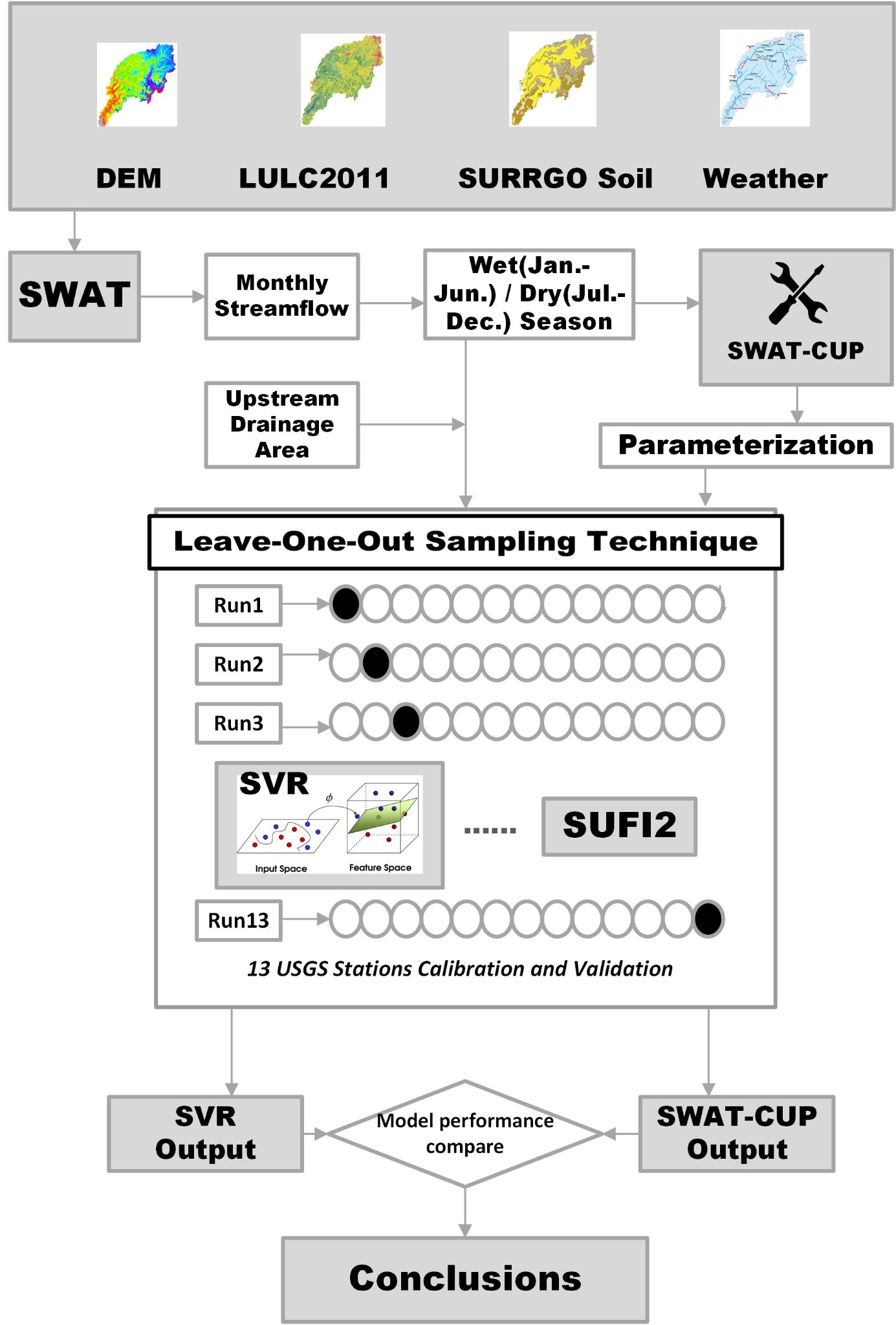
- Developed a hybrid SWAT–SVR framework using SWAT streamflow and upstream drainage area as support-vector-regression inputs.
- Applied spatial calibration and leave-one-out validation across 13 USGS stations in the Illinois River watershed, U.S.
- Compared the hybrid framework with conventional SWAT-CUP calibration.
- Evaluated annual and seasonal performance, flow-duration behavior, drainage-area suitability, and prediction across flow ranges.
Key Findings
- SWAT–SVR outperformed SWAT-CUP, particularly during the dry season, when all SWAT-CUP simulations were rated unsatisfactory.
- Annual SWAT–SVR simulations achieved satisfactory to very good performance at 67% of stations.
- Performance was strongest for medium flows of 5–30 m³/s and drainage areas of approximately 500–3,000 km².
- Flow-duration curves reproduced medium and low flows well.
- High flows above 30 m³/s remained difficult to predict because of limited training data.
- The framework reduced calibration effort to three primary SVR parameters: C, γ, and ε.
My Contribution
Lifeng Yuan developed the hybrid SWAT–SVR framework and contributed model implementation, data processing, machine-learning integration, statistical evaluation, visualization, and manuscript preparation.
Practical Relevance
The method offers a data-efficient alternative to conventional SWAT calibration for regional applications, data-limited watersheds, and ungauged basins by transferring spatial information from monitored proxy sites.