
Research summary · 2025
Evaluating Parsivel²’s Raindrop Data with Terminal Drop-Velocity Models
A combined laboratory and field evaluation of how terminal drop-velocity filters affect Parsivel² drop-size distributions and bulk rainfall parameters.
Research snapshot
How do theoretical terminal drop-velocity filters change Parsivel² drop-size distributions and rainfall parameters for artificial and natural rain?
Parsivel² · four-nozzle rainfall simulator · 10 natural events · 732 min artificial rainfall · six velocity filters
Improves rainfall-data quality control for stormwater modeling, radar interpretation, and rainfall-erosivity assessment.
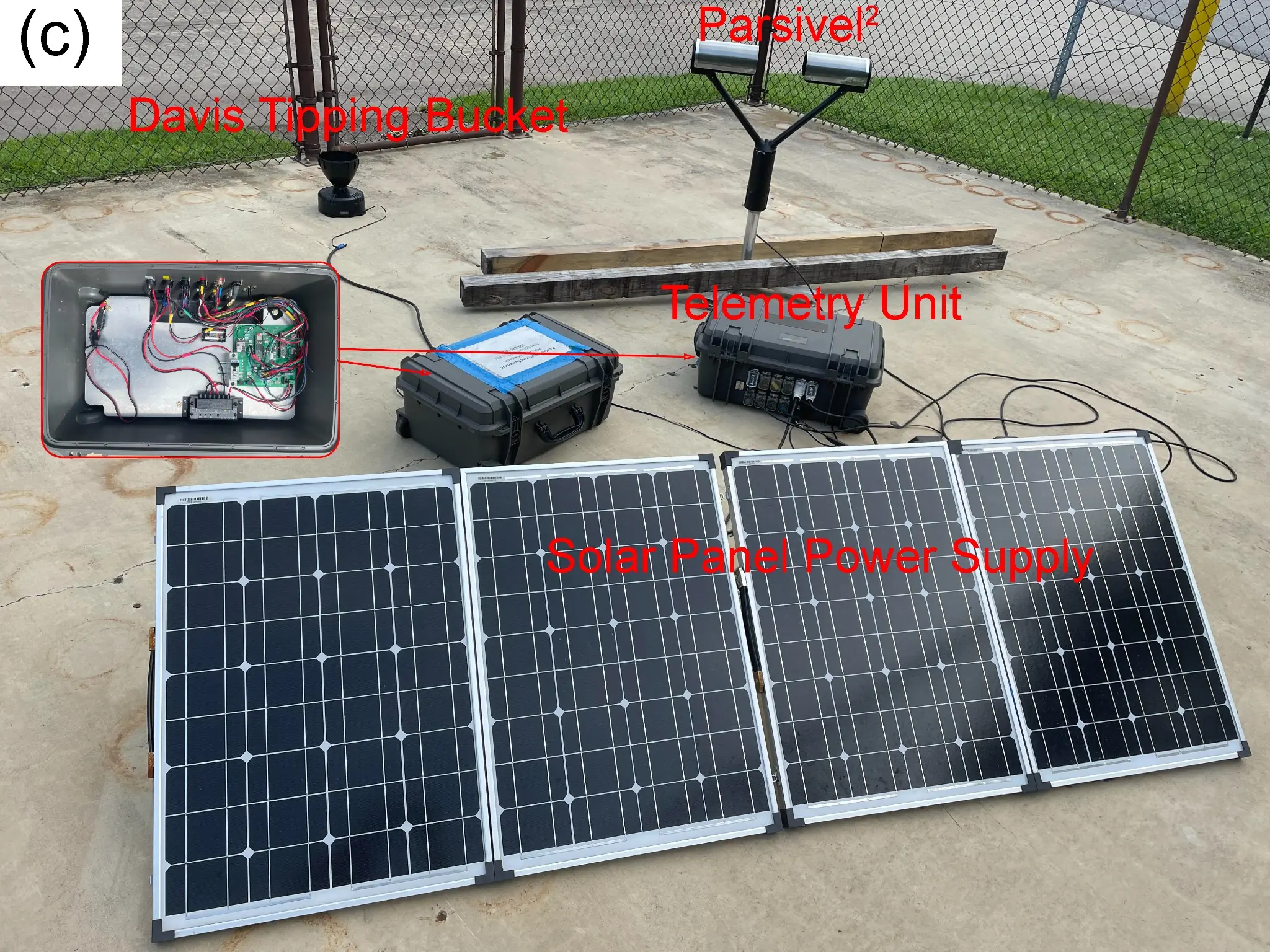 Outdoor field deployment
Parsivel² and Davis tipping-bucket instruments with telemetry and solar power for natural-rainfall monitoring.
Open full size
Outdoor field deployment
Parsivel² and Davis tipping-bucket instruments with telemetry and solar power for natural-rainfall monitoring.
Open full size
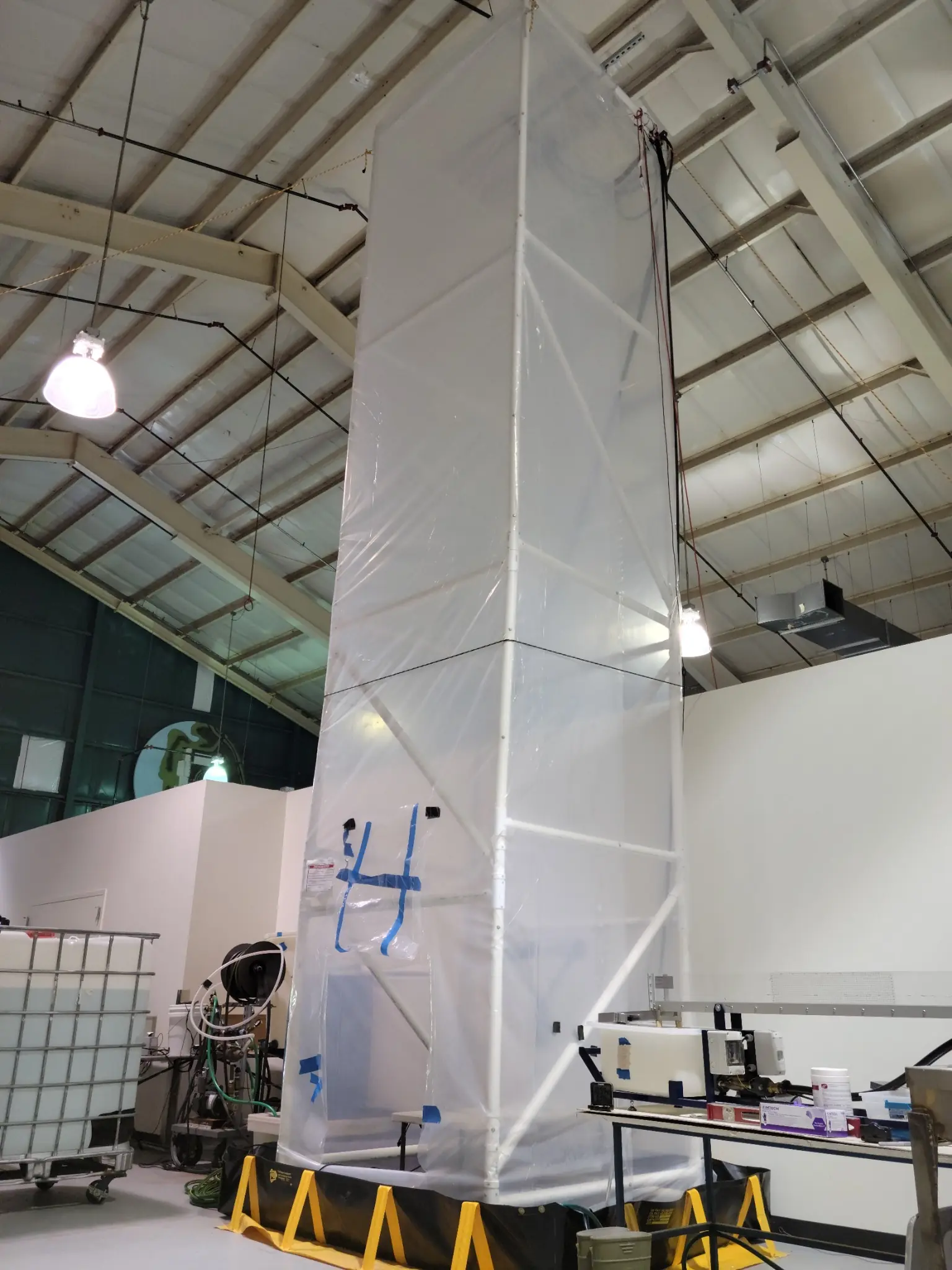 Artificial-rainfall facility
Enclosed rainfall-simulation chamber at the U.S. EPA Fluid Modeling Facility in Durham, North Carolina.
Open full size
Artificial-rainfall facility
Enclosed rainfall-simulation chamber at the U.S. EPA Fluid Modeling Facility in Durham, North Carolina.
Open full size
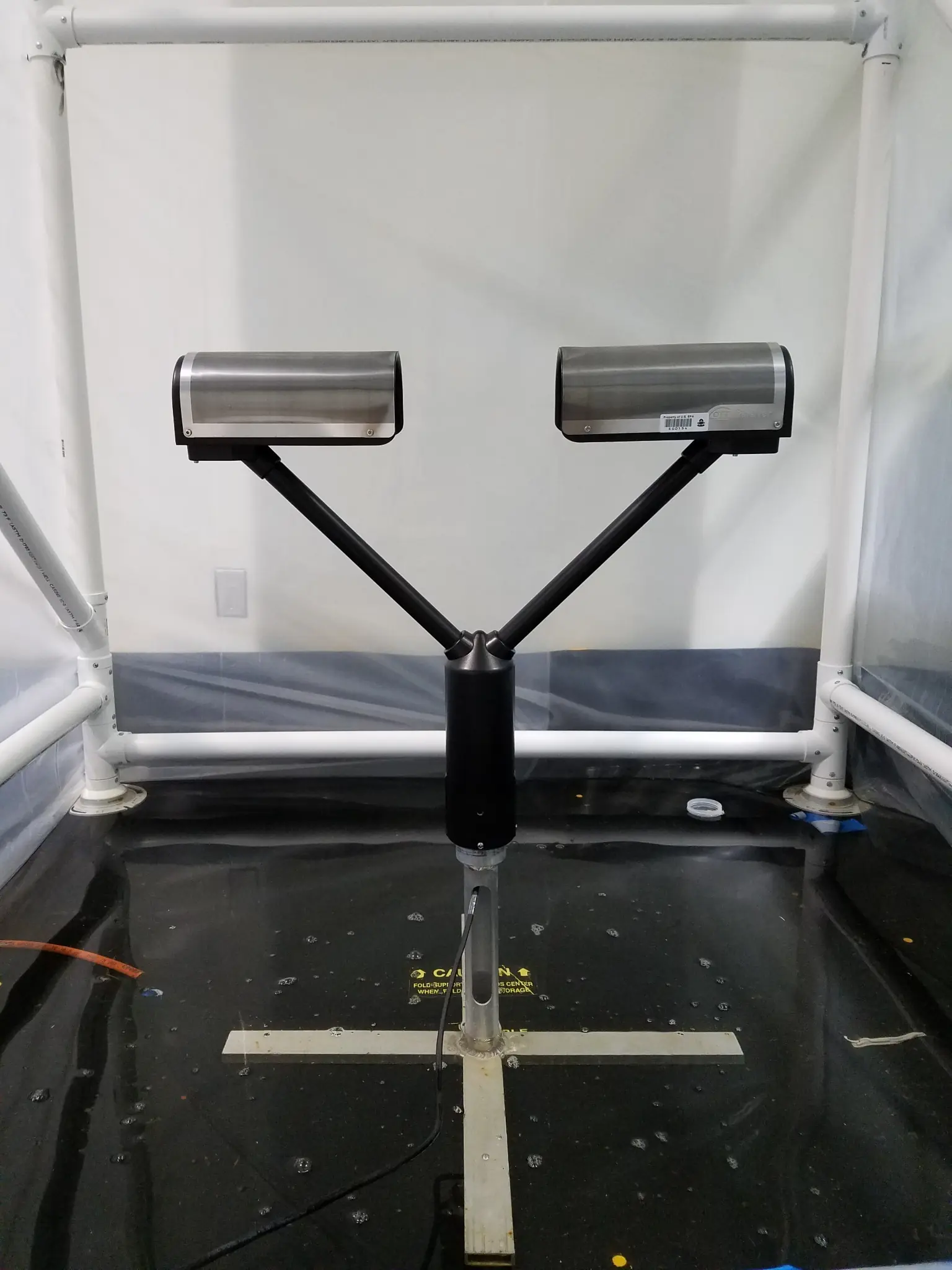 Parsivel² laboratory setup
Parsivel² positioned inside the simulator to measure artificial drop-size and velocity distributions.
Open full size
Parsivel² laboratory setup
Parsivel² positioned inside the simulator to measure artificial drop-size and velocity distributions.
Open full size Research Question
How does the choice of theoretical terminal drop-velocity model affect quality control of Parsivel² drop-size distributions and the calculation of bulk rainfall parameters under natural and artificially generated rainfall?
Why It Matters
Parsivel² disdrometers provide high-frequency measurements of particle size and fall velocity, but physically unlikely drops are commonly removed with theoretical velocity filters. Those filters can change drop counts, rain intensity, kinetic energy, and derived microphysical parameters. Understanding when they are appropriate is important for rainfall inputs used in urban stormwater modeling, radar quantitative precipitation estimation, and soil-erosion studies.
Methods
- Recorded 10 natural rainfall events with a Parsivel² disdrometer at the U.S. EPA Research Triangle Park campus in Durham, North Carolina, during June–July 2024.
- Generated 732 minutes of artificial rainfall with four nozzles at the U.S. EPA Fluid Modeling Facility.
- Compared the raw drop-size-distribution output and the instrument-calculated rainfall parameters.
- Evaluated six terminal-velocity relationships: Gunn and Kinzer (1949), Atlas et al. (1973), Beard (1976), Atlas (1977), Uplinger (1981), and Van Dijk et al. (2002).
- Examined changes in drop count, rain intensity, kinetic energy, mass-weighted mean diameter (Dm), normalized intercept parameter (log10Nw), liquid-water content, and radar reflectivity.
Key Findings
- For artificial rainfall, rain rates calculated from raw drop-size distributions were substantially higher than the Parsivel² instrument calculation and more closely matched independently collected water volumes.
- Applying theoretical terminal-velocity filters to artificial rainfall removed valid simulator-generated drops and could underestimate rain rate; filters developed for natural rainfall should therefore not be transferred automatically to artificial-rainfall experiments.
- For natural rainfall, the six filters produced similar results. Mean drop-count reduction was 0.14%, with the largest reduction—0.36%—from the Atlas (1977) relationship.
- Filtered-drop ranking for the accumulated natural events was Atlas (1977) > Uplinger (1981) > Atlas et al. (1973) > Beard (1976) > Van Dijk et al. (2002) > Gunn and Kinzer (1949).
- Filters affected Dm more strongly than log10Nw and had a larger influence on convective rainfall than on stratiform rainfall.
- Natural-rainfall liquid-water content and radar reflectivity peaked near 0.6–0.7 g m⁻³ and 30 dBZ, respectively.
My Contribution
According to the published CRediT statement, Lifeng Yuan was responsible for conceptualization, data curation, formal analysis, methodology, validation, visualization, and preparation of the original manuscript draft.
Practical Relevance
The study provides an evidence-based distinction between quality-control procedures for natural and artificial rainfall. It helps researchers avoid filtering artifacts, improves interpretation of Parsivel²-derived rainfall intensity and kinetic energy, and strengthens precipitation inputs used in stormwater, hydrologic, radar, and erosion applications.
Publication & Resources
Yuan, L., Mikelonis, A. M., & Sawyer, J. (2025). Evaluating Parsivel²’s raindrop data: A comparative study of different terminal drop velocity models on simulated and natural rain events. Atmospheric Environment, 362, 121548. https://doi.org/10.1016/j.atmosenv.2025.121548