
Research summary · 2022
Modeling surface runoff and soil loss response to climate change under GCM ensembles and multiple cropping and tillage systems in Oklahoma
A WEPP assessment of future runoff, soil erosion, and crop-production responses across 25 GCMs and 29 cropping and tillage systems in central Oklahoma.
Research snapshot
How will runoff, soil loss, and crop yield respond to future climate across diverse cropping and tillage systems in central Oklahoma?
WEPP · 25 GCMs · 100 climate scenarios · 29 cropping and tillage systems · RCP4.5 and RCP8.5
Identifies conservation systems that can reduce soil erosion and support climate-resilient agricultural management.
Research Question
How might future climate alter surface runoff, soil loss, and crop production under a broad range of cropping and tillage systems in central Oklahoma, and which management systems provide the most effective erosion control?
Why It Matters
Agricultural conservation planning must account for both uncertain future climate and differences among management practices. Evaluating only a small number of climate projections or management systems can obscure the range of possible hydrologic, erosion, and crop-yield responses.
Methods
- Generated 100 future climate scenarios from 25 downscaled GCM projections under RCP4.5 and RCP8.5 for 2021–2050 and 2051–2080.
- Combined the climate scenarios with 29 cropping and tillage systems.
- Applied the Water Erosion Prediction Project (WEPP) model to simulate surface runoff, soil loss, and crop production.
- Compared future simulations with baseline climate conditions for a USDA-ARS experimental site in central Oklahoma.
Key Findings
- Average annual precipitation was projected to decline by approximately 4–6%, while temperature increased under both RCP pathways and future periods.
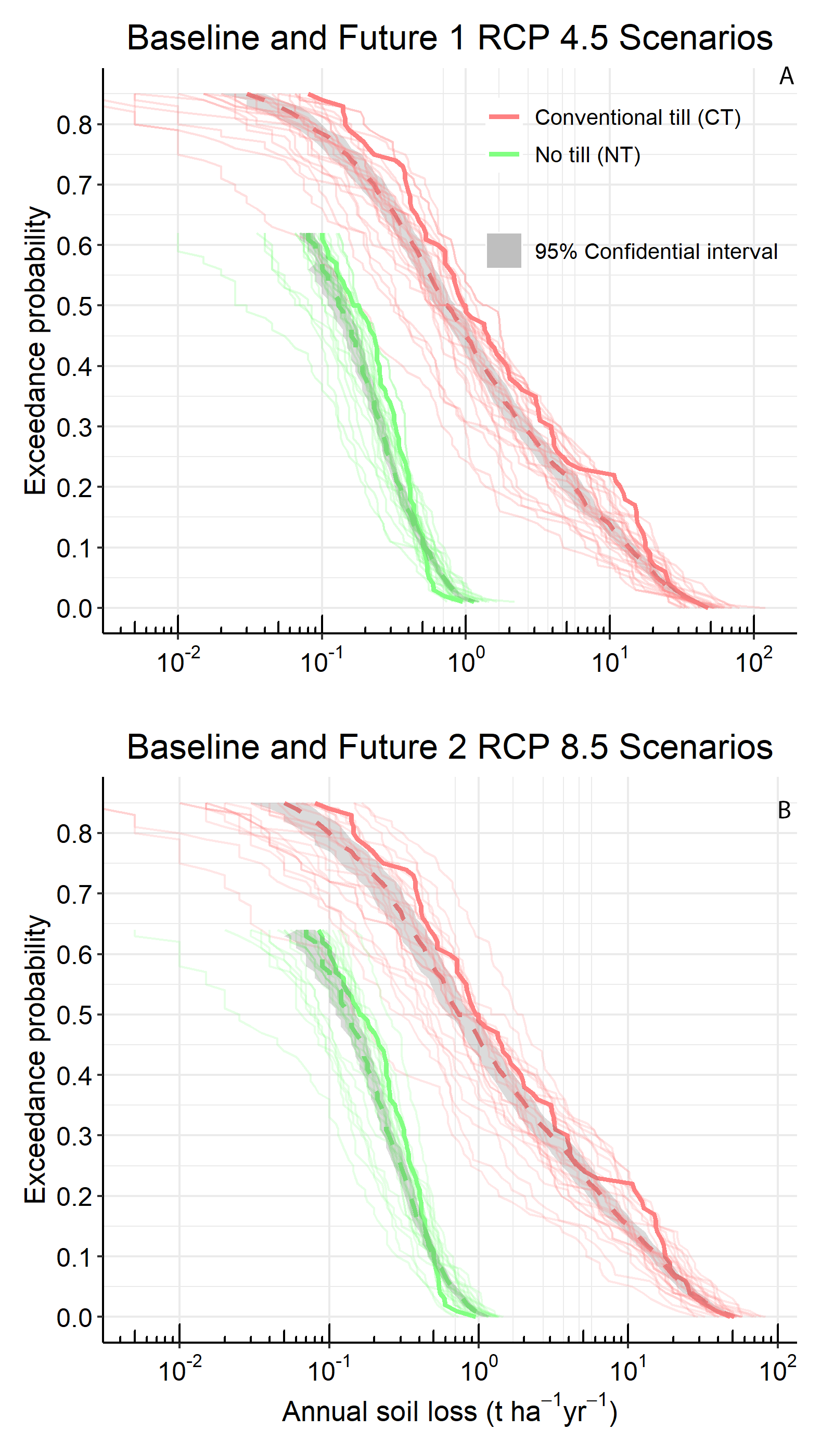
- Mean annual runoff and soil loss, averaged across the scenarios and crop types, decreased slightly, but responses varied substantially among individual GCMs and management systems.
- Except for cotton, simulated crop yields declined by approximately 10.3–18.3% during 2021–2080.
- No-till produced the lowest simulated soil loss among the evaluated tillage systems.
- Crop–alfalfa rotations and the wheat–soybean double-cropping system were among the more effective options for controlling erosion.
My Contribution
Lifeng Yuan led model development, workflow automation, data analysis, visualization, and manuscript preparation for the multi-scenario WEPP assessment.
Practical Relevance
The study demonstrates why agricultural climate-impact assessments should evaluate ensembles of climate projections together with a wide range of management systems. Its results support selection of cropping and tillage practices that maintain erosion control under uncertain future conditions.
Publication & Resources
Yuan, L., Zhang, X.-C. J., Busteed, P., Flanagan, D. C., & Srivastava, A. (2022). Modeling surface runoff and soil loss response to climate change under GCM ensembles and multiple cropping and tillage systems in Oklahoma. Soil and Tillage Research, 218, 105296. https://doi.org/10.1016/j.still.2021.105296