
Research summary · 2024
Exploring the Statistical Characteristics of Coastal Winter Precipitation Measured using a Parsivel² Disdrometer: A Case Study in North Carolina
A Parsivel² disdrometer study of coastal winter precipitation microphysics in North Carolina.
Research snapshot
How do coastal winter precipitation types differ in particle-size distribution and fall velocity?
Parsivel² disdrometer · precipitation-type classification · drop-size and velocity–diameter analysis
Improves precipitation characterization for forecasting, radar validation, runoff, and erosion modeling.
Research Question
How do particle-size distributions, fall velocities, and statistical characteristics differ among coastal winter precipitation types in North Carolina?
Why It Matters
Coastal winter storms can shift rapidly among rain, snow, and mixed precipitation. Better characterization of these microphysical transitions can improve precipitation estimates, radar interpretation, runoff and erosion modeling, and short-term forecasting.
Methods
- Collected high-resolution winter observations with an OTT Parsivel² optical disdrometer in coastal North Carolina.
- Classified events as stratiform, convective, or mixed precipitation.
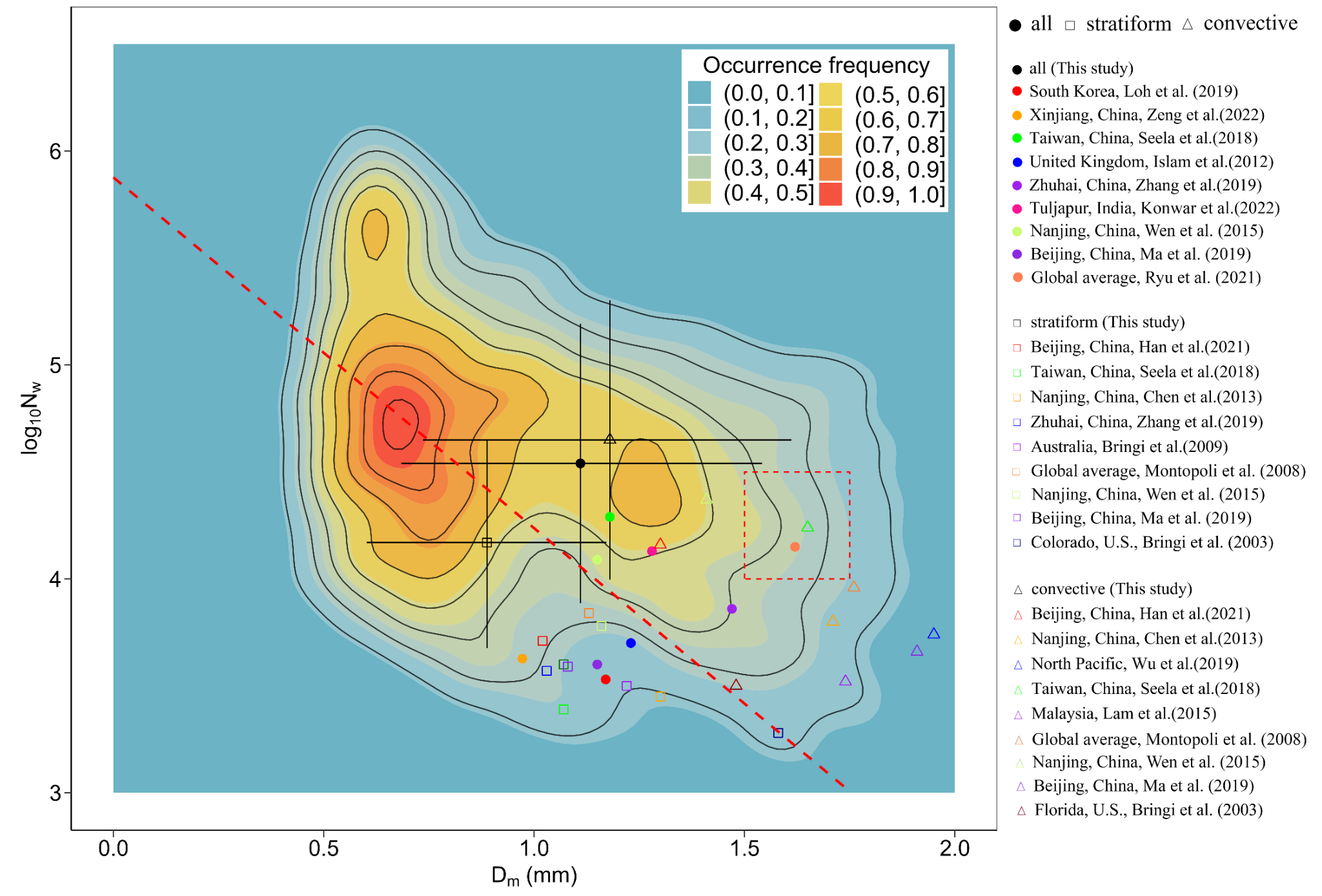
- Analyzed particle-size distributions and velocity–diameter relationships.
- Evaluated statistical properties including mean particle diameter, number concentration, and radar reflectivity.
Key Findings
- Rain showed narrower particle-size distributions with a higher concentration of small drops.
- Snow displayed broader distributions with larger, slower-falling particles.
- Mixed precipitation showed high variability and overlapping distribution characteristics.
- Velocity–diameter relationships deviated from idealized models, especially during snow events, likely because of particle shape and turbulence.
- Parsivel² observations captured microphysical transitions in real time.
My Contribution
As first author, Lifeng Yuan contributed to the disdrometer-data analysis, interpretation of precipitation-type differences, scientific visualization, and manuscript development.
Practical Relevance
The study demonstrates how disdrometer observations can improve understanding of rapidly changing coastal winter precipitation and provide evidence for forecasting, radar validation, and hydrologic and erosion modeling.